
Video editing contract template for freelancers (free, copyable)
Scope, revision limits, feedback deadlines, payment, file ownership and a kill fee. A plain-language starting point you can adapt for each client.
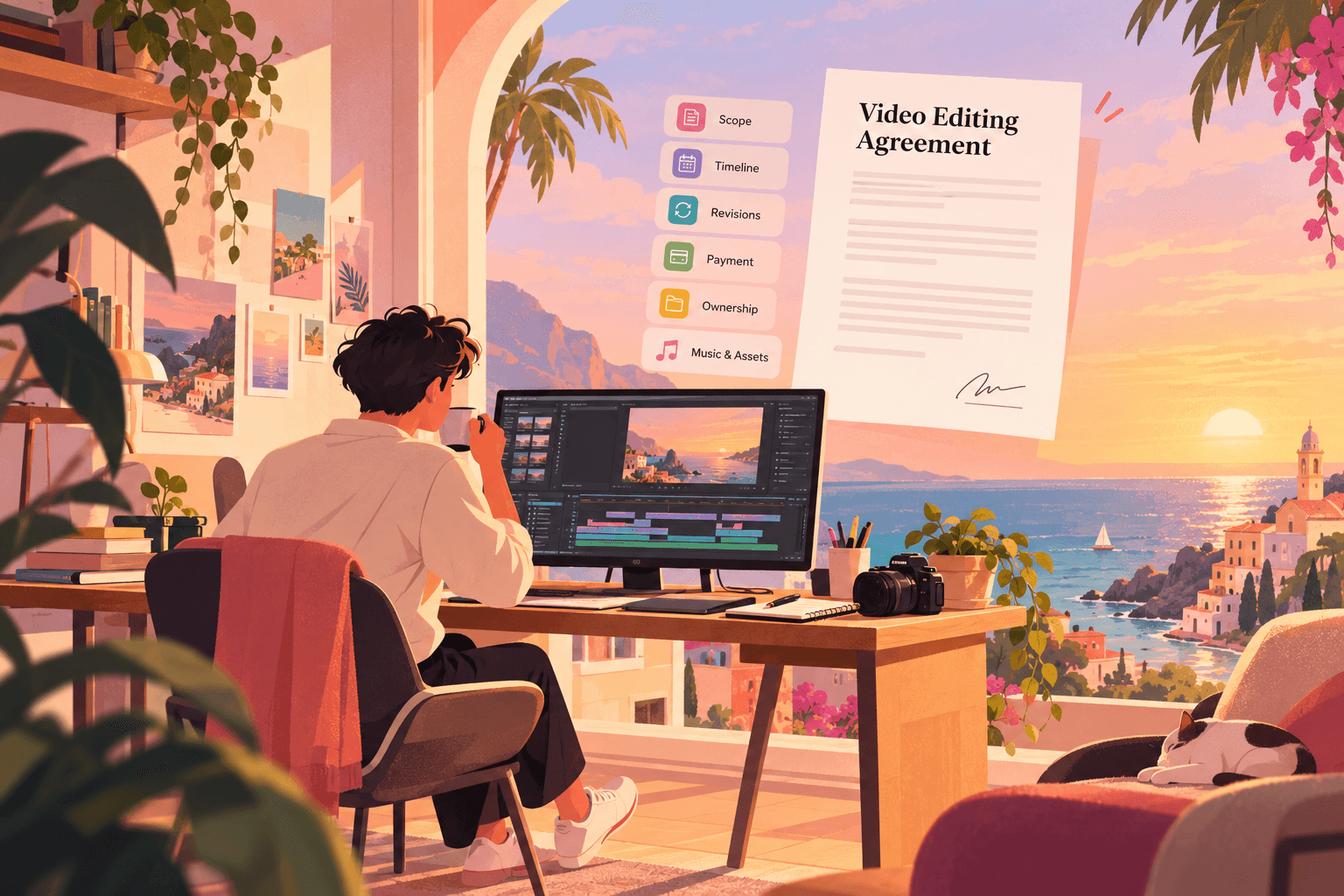
Most freelance editors start without a contract. It works until the client who "just needs one more change" turns a three-day job into three weeks, or the invoice sits unpaid because "the video isn't finished yet."
A contract doesn't need to be long to prevent that. It needs to answer, in plain words, the questions you'd otherwise argue about later.
This is a starting point, not legal advice. Laws on contracts, tax and intellectual property differ between countries. If a project is large, or the client sends their own contract, have a lawyer read it.
What a video editing contract should cover
Who and what. The parties, the project and the deliverables.
Timeline. When footage arrives, when cuts are due, and what happens if footage is late.
Revisions. How many rounds, what a round is, and what extra rounds cost.
Feedback. How notes are given and how long the client has to give them.
Payment. Amount, currency, deposit, due dates, late payment.
Ownership. Who owns the final video, the project files and the raw footage.
Music and assets. Who licenses music, fonts and stock, and in whose name.
Cancellation. What happens if the project stops halfway.
Credit. Whether you can show the work in your portfolio.
The template
Replace everything in [brackets].
VIDEO EDITING AGREEMENT

Between: [Your name / business], "the Editor"
And:     [Client name / business], "the Client"
Date:    [date]

1. PROJECT
The Editor will edit [number] video(s) for [channel / brand /
purpose] from footage supplied by the Client.

Deliverables:
- [e.g. one 10 to 14 minute 16:9 video, 4K H.264]
- [e.g. two vertical Shorts under 60 seconds]
- [e.g. thumbnail-ready still frames]

2. TIMELINE
The Client supplies all footage and assets by [date].
First cut: within [5] working days of receiving everything.
Each revised version: within [3] working days of receiving notes.
If footage or notes arrive late, deadlines move by the same time.

3. REVISIONS
The fee includes [2] rounds of revisions.
A round is one consolidated list of notes from all reviewers on
one version. Revisions are changes within the agreed brief.
New footage, new sections, new formats or a changed script are
new scope and quoted separately.
Further rounds: [amount] each.
Corrections of the Editor's own errors are free.

4. FEEDBACK
The Client gives notes through [review link / tool], with
timecodes where possible, within [3] working days of each version.
If no notes arrive within [10] working days, the version is
considered approved.

5. PAYMENT
Total fee: [amount and currency].
[50]% deposit before work starts, non-refundable once the first
cut is delivered.
Remaining [50]% due on approval of the final version, before
final files are delivered.
Invoices are due within [7] days. Late payments: [terms].

6. OWNERSHIP
On full payment, the Client owns the final delivered video(s).
Project files (e.g. Premiere, Resolve) remain with the Editor
unless bought separately for [amount].
The Client confirms they have the rights to all supplied footage,
music and assets.

7. MUSIC, FONTS AND STOCK
[The Client / The Editor] licenses music, fonts and stock footage,
in [the Client's] name. Licence costs are [included / billed at
cost].

8. CANCELLATION
If the Client cancels after work starts, the deposit is kept and
work done beyond it is billed at [rate]. If the Editor cancels,
the deposit is refunded in full and all work so far is handed
over.

9. CREDIT AND PORTFOLIO
The Editor may show the published video in their portfolio
[after it is public / with permission / not at all].

10. FILE STORAGE
The Editor keeps project files and footage for [60] days after
delivery, then may delete them.

Signed:
Editor: ____________  Date: ______
Client: ____________  Date: ______
Notes on the clauses that cause the most trouble
Revisions
The revision clause is the one you'll point to most often. Define a round, or the number means nothing. Our guide to how many revision rounds to include explains the trade-offs and how to price extra rounds.
Approval by silence
The "considered approved after 10 working days" line in clause 4 stops projects stalling forever because the client went quiet. Keep it, and remind the client a few days before it applies.
Final payment before final files
Deliver review versions through a review link (with downloads off), and send the full-quality final files after the last payment. It's the simplest way to avoid chasing invoices. In Seamlift, share links can have downloads turned off, a password, and an expiry date, so clients can watch and comment without taking the file.
Project files
Clients sometimes assume they own your Premiere or Resolve project. Most editors keep them unless they're paid for separately, because a project file is how you work, not what you sold. Either way, write it down.
Currency and tax
If you work across borders, say which currency the fee is in and who pays transfer fees. If you're registered for GST, VAT or similar, say whether the fee includes it.
Getting it signed without friction
Send it as a short PDF or e-signature document with the quote, not after work starts.
Keep the language plain. Clients sign faster when they can read it in five minutes.
Use the same template for every client and only change the brackets.
FAQ
Do I need a contract for small projects?
Even a one-paragraph email agreement with scope, revisions, price and payment date is better than none. Ask the client to reply "agreed."
What if the client sends their own contract?
Read it for the same nine points. Look especially at ownership (some ask for your project files and all raw material), payment terms (60 or 90 days is common for larger companies) and unlimited revisions.
Is a deposit normal for video editing?
Yes. 30 to 50 percent upfront is common, especially with new clients.
How do I prove which notes came when?
Keep all review in one place, with versions numbered and notes pinned to the version they were left on. That record settles most "we asked for that in round one" arguments. Seamlift keeps every version and its comment thread together, free up to 10 GB. Try it free.
- template
- freelance
- client-review